
Quick Summary
Learning how to troubleshoot a 48v forklift battery charger helps prevent unnecessary downtime and protects battery performance. Charging problems often come from voltage mismatches, damaged connectors, battery degradation, or internal charger faults. Identifying issues early improves reliability and reduces operational interruptions. Understanding charger compatibility, battery condition, and charging behavior also helps businesses make better decisions when replacing batteries or upgrading equipment.
Forklift charging issues rarely appear without warning. Operators usually notice slower charging times, incomplete charging cycles, or batteries losing runtime sooner than expected. Learning how to troubleshoot a 48v forklift battery charger early can help prevent unnecessary downtime and avoid larger operational disruptions.
When a charger stops working properly, operations slow down quickly. Equipment may sit idle between shifts, productivity drops, and battery strain increases. In busy facilities, even one failed charger can disrupt scheduling across an entire fleet.
This is especially important for 48V systems because they are widely used in medium and heavy-duty electric forklifts. A charger problem affecting a 48V battery can impact multiple daily operations if not addressed early.
Understanding What Causes Charger Failures
Many charging problems are not caused by the charger itself. In many cases, the issue starts with damaged connections, unstable power supply, or declining battery condition.
Loose terminals create inconsistent current flow, while corrosion restricts conductivity. Over time, this reduces charging efficiency and creates heat buildup around the connectors.
Voltage incompatibility is another common issue. A charger must match the battery system exactly. Using incorrect charger settings for 24V, 36V, 48V, or 80V systems can prevent charging entirely or damage the battery over time.
Internal charger failures can also develop through worn components such as fuses, relays, or circuit boards. These failures often appear gradually before the charger stops functioning completely.
How To Troubleshoot a 48V Forklift Battery Charger Safely
The first step when troubleshooting a charger is verifying the power source. A tripped breaker, damaged outlet, or unstable power supply can interrupt charging before power ever reaches the battery.
Testing the outlet with another device helps confirm whether power is available. Power cords should also be checked for cuts, heat damage, or loose connections.
After confirming power supply, inspect all charger cables and battery terminals carefully. Dirt, corrosion, and loose connections reduce charging efficiency and may interrupt the charging cycle completely.
Operators should also inspect connector alignment. Bent or partially connected terminals can create intermittent charging problems that are difficult to identify during normal operation.
Why Battery Condition Directly Affects Charging Performance
A charger cannot compensate for a battery that is already failing. In many cases, charging problems actually begin with declining battery health rather than charger failure.
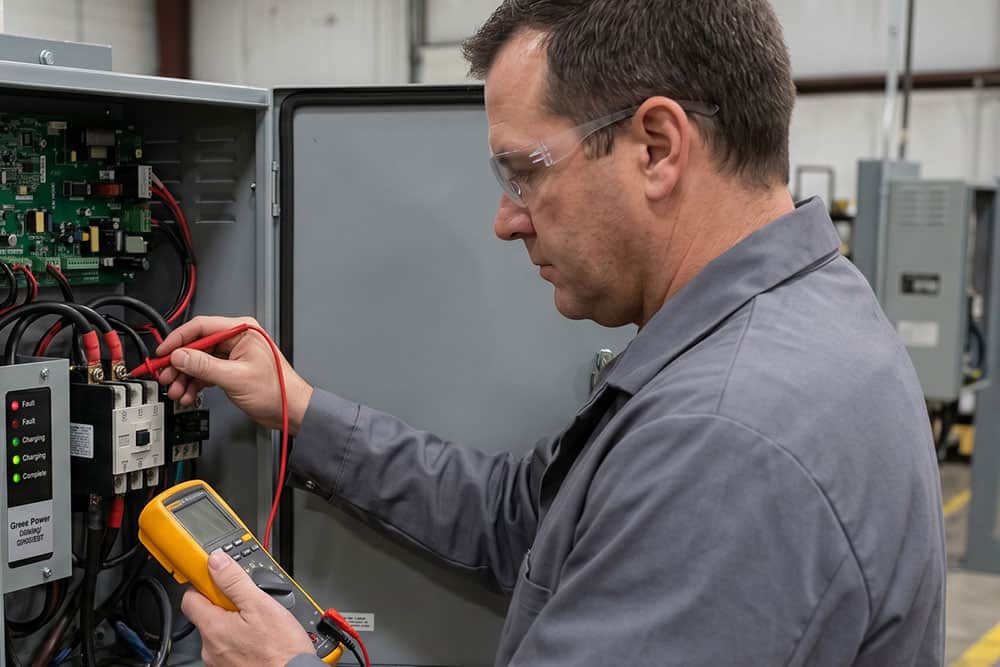
Testing battery voltage with a multimeter helps identify whether the battery is accepting and holding charge properly. In lead-acid systems, a fully charged battery should stabilize between 2.1 and 2.2 volts per cell.
If voltage remains consistently low after charging attempts, the battery may no longer be operating efficiently.
This becomes more noticeable in demanding operations where forklifts run multiple shifts or carry heavy loads throughout the day.
The Role of Maintenance in Preventing Charger Issues
Consistent maintenance reduces many common charging problems before they affect operations.
Battery terminals should remain clean and free from corrosion buildup. Cables should be inspected regularly for wear or heat damage. Ventilation around charging stations should also remain unobstructed to prevent overheating.
Charging habits matter as well. Batteries repeatedly left in partial states of charge or connected to incorrect chargers tend to develop performance issues more quickly.
Facilities that follow structured charging procedures generally experience fewer interruptions and more stable battery performance.
Why Charger Compatibility Matters More Than Many Operators Realize
Not every charger works properly with every battery type. This becomes increasingly important as more operations transition toward lithium-ion batteries for forklifts.
Lithium-ion systems charge differently than traditional lead-acid batteries. Using incompatible chargers can create incomplete charging cycles, overheating, or long-term battery stress.
Operations upgrading battery systems should always confirm charger compatibility before installation. Charging software, voltage configuration, and output settings must align with the battery’s requirements.
Ignoring compatibility often leads to avoidable charging failures and reduced battery efficiency.
When Charging Problems Point Toward Battery Replacement
Some charging issues continue even after troubleshooting steps are completed. In those situations, the battery itself may be nearing the end of its usable performance range.
Repeated charging failures, reduced runtime, and unstable voltage output often indicate internal battery degradation.
At that stage, continuing to operate aging batteries creates additional strain on both chargers and equipment.
This is where evaluating new forklift batteries becomes practical. Replacing declining batteries improves charging consistency, operational reliability, and equipment performance.
How Lithium-Ion Systems Change Charging Expectations
As more operations adopt lithium-ion technology, charging behavior changes significantly.
Lithium-ion systems support faster charging and opportunity charging throughout the day. This reduces downtime between shifts and eliminates several issues associated with traditional watering routines.
Because lithium-ion batteries maintain more stable output during discharge, forklifts operate more consistently under load.
However, these systems still require proper charger configuration and monitoring. Faster charging only improves performance when the charging system is designed correctly for the battery.
Why Fast Troubleshooting Prevents Larger Operational Problems
Small charging problems often become larger operational failures when ignored.
A loose connection today can become a failed charging cycle tomorrow. Inconsistent charging eventually reduces runtime, increases downtime, and affects scheduling across the facility.
Troubleshooting should not only focus on fixing immediate issues. It should also identify patterns that suggest declining battery performance or aging charging equipment.
Early intervention keeps operations more predictable and reduces unexpected interruptions.
Get Charging Performance Back Under Control
If charging issues are affecting productivity, runtime, or equipment reliability, addressing the problem early can prevent larger operational disruptions. Contact Green Power Forklift Batteries today for straightforward guidance on compatible chargers, battery configurations, and replacement options designed to keep your fleet operating consistently and efficiently.
Keep Your Fleet Powered Without Charging Delays
Charging problems can quickly impact productivity, battery performance, and daily operations. Green Power Forklift Batteries provides dependable solutions for batteries and forklift battery chargers designed to support consistent performance across demanding work environments.
Contact us today for a fast quote, expert guidance, and the right charging setup for your equipment, voltage requirements, and operational workload.
FAQs
What is the first step to troubleshoot a 48v forklift battery charger?
Start by checking the power source, outlet condition, and circuit breaker. Then inspect charger cables and battery connections for damage or corrosion.
Can a weak battery cause charger problems?
Yes. Batteries with low voltage or internal degradation may fail to accept or maintain a charge even when the charger is functioning properly.
Why is charger compatibility important for lithium-ion batteries?
Lithium-ion systems require chargers designed for their charging profile and voltage requirements. Incorrect chargers can reduce performance or damage the battery.


